
Zarla Ludin: The Spare Studio
Instagram: @thesparestudio
Rockland, MA
Acrylic/mixed media on wood or paper
I’ve always been fascinated by the idea of traveling between dimensions. To me, artists are the world’s true dimensional travelers—taking complex, "higher" ideas and pinning them down into a form we can actually see and touch. This kind of exploration shouldn't be a solo trip, though. When we look at these different "slices" of reality together, we’re reminded that everyone sees the world from a unique angle. This approach turns art into a shared journey that encourages us to listen better and realize that no one has the whole story on their own. By exploring these big concepts as a community, we find a common language for the things we can’t always see, proving that we only get the full picture when we look at it together.
4 SHORT STORIES ABOUT
THE SPARE STUDIO
I am a resilient art resource for the South Shore and beyond.
Art reminds us to continue learning and expressing ourselves.
Artists can express themselves in so many different ways, and they have the power to bring peace and perspective-shifting to our world.
Just because you aren’t creating a work of art doesn’t mean you don’t work in art.
What role do you play in the arts community, and what does that role mean to you personally?
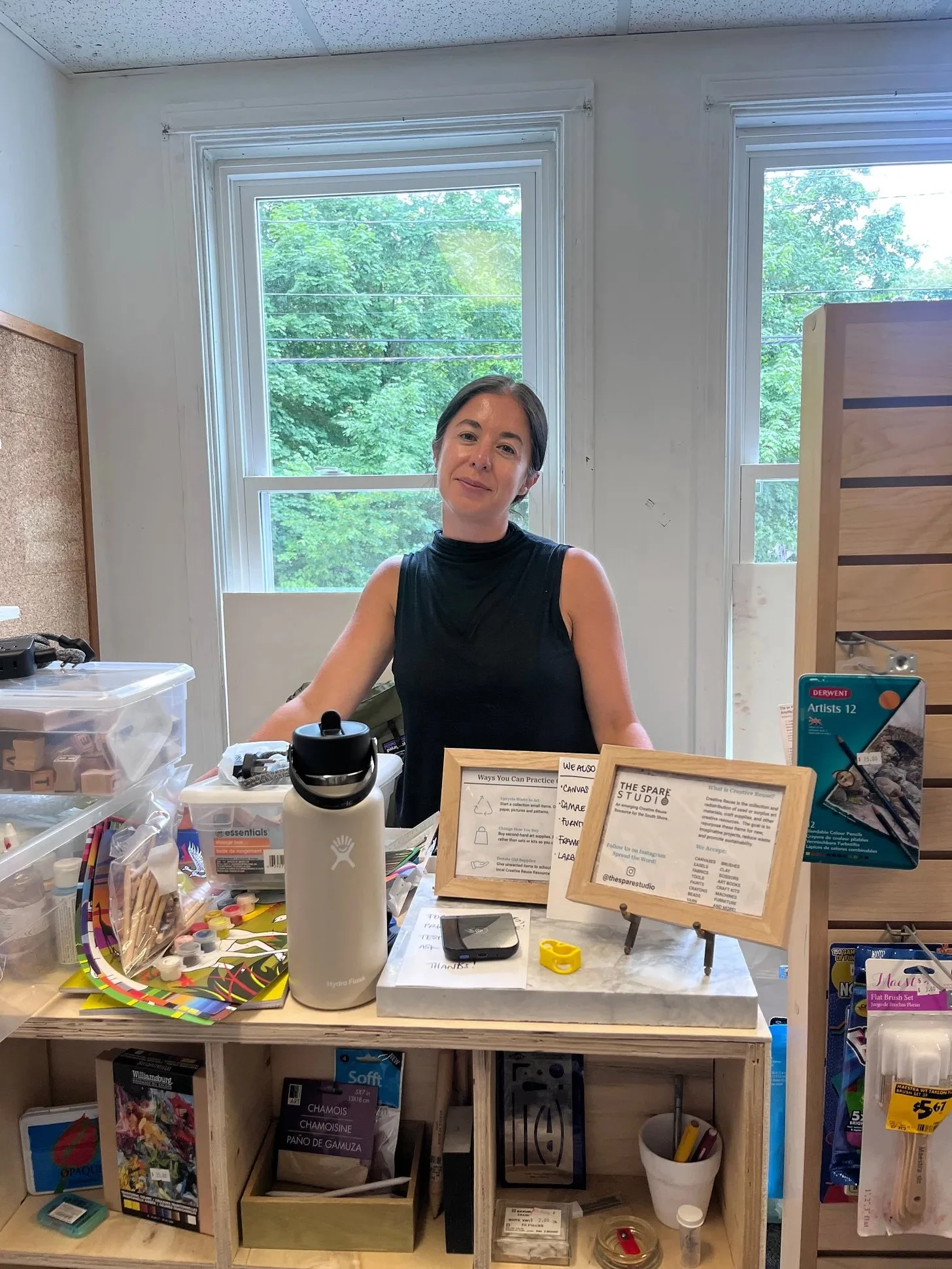
I own and operate a second-hand art supply store and creative reuse center, but I like to think of myself as a matchmaker between creators and the tools they need. My role is to provide the South Shore with an affordable, accessible resource for materials while ensuring that languishing supplies find a second life instead of a landfill.
To me, this work is deeply personal. Growing up, I loved art but lacked the means to afford quality supplies or the guidance to build a kit. Today, I get to bridge that gap. Whether I’m helping an artist find a creative 'workaround' for a project or providing free materials to teachers and arts organizations, I’m not just selling supplies—I’m removing the barriers to entry for our entire creative community.
What led you to this work?
My path to this work was a transition from designing for 'disruption' to designing for impact. In my career in product development and design strategy, I spent years helping major brands navigate nascent problems and exercise their creative muscles. However, in that world, the output is often internal, abstract, or doesn’t turn into anything real for the market. I found myself craving the direct, visible impact of service design—the kind of work I did for municipalities where you can see the community change in real-time.
I decided to bring that strategic lens closer to home. I’ve always been fascinated by the 'biographies' of products—the brand histories and technical specs of the tools we use. By opening the Spare Studio, I’ve filled an art supply retail vacuum on the South Shore, combining my expertise in product curation with a service-based mission. I’m no longer just keeping designers 'fresh'; I’m putting the actual tools of creation into their hands.
Why does this work matter, especially right now?
The landscape for artist supply choices has shifted dramatically in recent years. With the closure of independent shops across Massachusetts, the bankruptcy and consolidation of national giants like Joann Fabrics, and the homogenization of brick-and-mortar suppliers like Michaels, creatives are losing their power of choice. We have to go online to buy, whether we like it or not.
On the South Shore, this void of art supply stores is especially felt. I learned about artists' frustrations with waiting for ordered supplies, over-ordering to avoid shipping fees, and not being able to play and explore art supplies without making a purchase commitment.
While I initially considered a traditional retail model with new art supplies, I realized that the new product cycle didn’t solve the larger issue. After discovering the movement of creative reuse centers, our mission became clear. We have an abundance of high-quality materials already sitting in homes in our neighborhoods; we simply lack a hub to harbor, channel, and recirculate them. Beyond economics, I wanted to provide a space that aligns with values allowing artists to reduce their environmental footprint without sacrificing the quality of their tools.
How does your work help artists or creative people grow, connect, or feel supported?
I view my role as a matchmaker for creativity. While we provide the tools, the real magic happens when our space becomes a social anchor where artists connect and share their work. I take pride in hearing specific needs and finding ways to fulfill them through my network. I’ve seen this in action through our community requests. I use my social media to post a call for specific items, and have had them appear anonymously on my doorstep within 24 hours.
There is a palpable sense of relief when people walk through our doors. Whether they are offloading supplies they no longer use or finding the exact tool they need at a price they can afford, they feel supported. We are more than a retail outlet; we are a cycle of support that keeps the local arts ecosystem healthy.
What impact are you most proud of so far?
I am most proud that I am doing this without the stressors of running a small business. I am very lucky to be in a space that supports the arts economy - The Wright Building. If every month I was hustling to save pennies, I wouldn’t be able to do this kind of work. But, I am not because I am focusing on the service of redistributing art supplies rather than things like aesthetics or expansion. I hope to keep this business running sustainably.
What challenges have you had to navigate in building or sustaining this work?
There is a persistent pressure in the business world to 'grow or die,' and my biggest challenge has been resisting that. I operate a for-profit business, but my metrics for success look very different from a traditional retail shop. I don’t want to use capital for massive marketing, gussying up a fresh shop, or expansion; I want to meet my community’s needs exactly where they are.
This often leads to the question: Why aren't you a non-profit? My answer is that I want to support the incredible non-profits already doing the work, rather than competing with them for limited arts resources. I have the products and the space to generate my own sustainability. While being in this in-between space can lead to a lot of overexplaining, I’ve realized that I’m fine with the confusion. As long as we are saving materials from the landfill and providing space for art to happen, the structure is working exactly as it should.
How do you define “community” in the context of the arts?
In the arts, I define community as an inclusive, open landscape where we explore the creative process together. Most importantly, I believe there is no hierarchy in progress; it’s not about getting better or bigger than one another, but about recognizing that everyone has a unique job and a vital purpose.
My inspiration for this definition comes directly from the arts community here on the South Shore. This community is remarkably joyful, fun, and supportive. I have seen so many people come forward to champion what we’re doing at the studio, and their collective energy is what fuels my belief that we don't need a ladder or ceiling, we just need each other.
What are you actively building or dreaming about next?
Looking ahead, I want to invest in the people behind the art as much as the tools they use. My next step is to bring on student interns from area art schools, bridging the gap between their creative training and the practicalities of running a mission-driven business. I’m also working to turn our studio into an engine for artist income, opening our space for workshops and exploring new ways for local makers to earn both active and passive income through our platform.
Equally important is a project close to my heart: Artist Estate Management. One of the most surprising challenges for the families of creators is navigating the transition of a life’s work and the supplies that come with it. I am currently collaborating with partners to help families manage these estates, ensuring that an artist’s creative legacy—and their physical materials—find a purposeful home rather than a storage unit or a landfill. My goal is to provide a dignified, strategic path for these collections, keeping them within the creative ecosystem they helped build.