Alisha Kelly: Les Feuilles Mortes
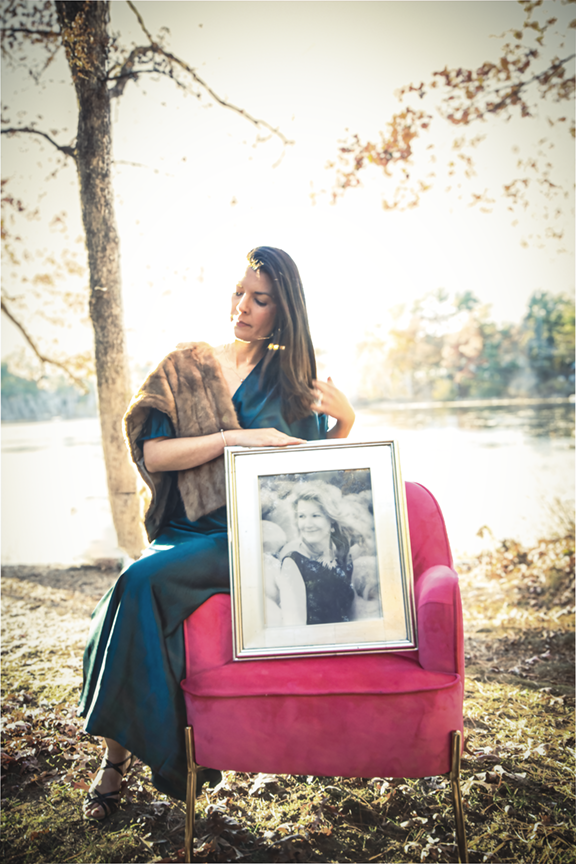
Photo: Bridget Ryan Snell
SHE WAS A BLONDE, I, A BRUNETTE. It was a contrast that seemed to define us in more ways than one. “Angel,” she used to call me. “When I saw your jet-black hair and your red and olive skin, I asked the nurse if she handed me the right baby.” She would smile as she told the story, recounting the day I was born. I was her “little papoose.”
She came from a large Irish Catholic family of nine. I, her only child.
She shone in the spotlight, so comfortable and at ease at center stage. I, shy and reserved, was drawn to quieter art forms, expressing my inner world through dance and deciphering the deeper meanings left behind on canvases, always preferring my place on the periphery.
She was a singer. As a young girl, I occasionally accompanied her to her weekly gig at a 1930s Cape Cod cottage-converted restaurant. I would sit on my stool, stage left, coloring, while she belted out Linda Ronstadt and Fleetwood Mac to a hazy, dim room of patrons who smiled and applauded as they dined. At the close of her show, she’d take my three-year-old hand in hers and walk me across the stage in our matching velour dresses she sewed us, singing Billie Holiday’s “God Bless the Child.”
Those memories are buried in the dusty corners of my mind, like the faded photographs from the early ‘80s, their edges blurred with a sepia tint. Her voice, distinct and rich, still clearly resonates within me.
My mom soon realized that singing in smoky restaurants wasn’t conducive to being the mom she wanted to be, as she became a single mother. Determined to be self-reliant, she put herself through grad school and pursued her second passion: social work, where she could channel her deep compassion. Her singing became her side hustle.
She sang ballads that she and my stepdad composed. They recorded them for demos they sent to New York and London, in pursuit of their dream. She led our congregation in hymnals, her voice filling the church, as I, in my teenage angst, would sink lower in my seat, raising my hymnal to cover my embarrassed face. And years later, she sang in jazz quartets, at galleries and events, collecting a wonderful group of musician friends.
Second to singing was her love of vacations. And she and I were a traveling duo. As a young girl, with resources slim, we camped and stayed with family in the White Mountains. As time went on, we stayed in B&Bs and with family across the English and Scottish countryside. Then, one day in eighth grade, I remember her excitedly telling me, “Lishy!” waving a handful of tri-fold travel brochures (there was no worldwide web yet) “We’re going to walk along pink sand beaches and swim in crystal water caves! We’re going to Bermuda!” Even though we lived on a seven-mile peninsula framed by hundreds of miles of beaches, we were both excited about this tropical and exotic adventure.
Each year, there was a new place. A trip to Quebec, “So you can practice your French, Lishy.” DC, for the history, and Florida for the warmth. Eventually, I took my own trip away from our seasonally sleepy seaside town and moved to the big city. Though my life had changed after moving to the city, our adventures together continued. Only a couple of hours away, she would visit me, and we’d meander through the Boston Garden. We had afternoon tea at the Ritz, admired the fashions and fine art through the brownstone windows of Newbury Street, and spent afternoons at the MFA. I’d tell her the stories behind the dramatic paintings, the tortured lives of the artists who created them.
Along our walks, she always dropped money into the cups held by the trembling hands of homeless people we’d pass. Her empathy and convictions superseded any dismissive judgment. Sometimes, we ventured into the tea room in Downtown Crossing to see what our tea leaves foretold of our futures. Not once did they reveal what would forever alter our lives.
Her diagnosis came as a shock: late-stage ovarian cancer, at just 52. But we kept our hope and didn’t let it derail our next adventure: France. We drove through the Dordogne River Valley, in awe of the ingenuity and creativity of prehistoric peoples’ cave drawings and the villages they carved in the sides of cliffs. We made our pilgrimage to Lourdes, and marched in its candlelight procession, bought bottles of its healing holy water, and prayed for a miracle.
We visited the Louvre, Versailles, and walked the steps of Montmartre to have our portraits sketched by street artists on the same cobblestone walkways where Monet, Renoir, and Degas once painted. And in that very same place where Edith Piaf once sang, my mother had a chance to take the stage, her voice now soft, slower, and filled with a quiet strength, she sang Edith’s song…
“…And soon I’ll hear old winter’s song…but I’ll miss you most of all, my darling, when autumn leaves start to fall…”
I stood up and clapped as hard and loud as I could, exclaiming “Bravo!” My cheeks flushed with pride and admiration this time, with a tinge of sadness. I was never more proud to be her daughter. I knew it took all the strength she had to get up and sing that day. But she did. She accomplished her goal of singing in the famous Parisian jazz clubs.
On our way back to the hotel, as we rushed to board the Metro just inches apart, the doors abruptly slammed shut between us and we were suddenly separated—in a foreign city. Without a phone or any way to reach her, panic set in. I feared I wouldn’t be able to find her again. I got off at the next stop and prayed that somehow, some way, she would, too.
I waited. Trains passed, minutes felt like hours, and my heartbeat pounded in my chest. I froze. Then, finally, through the noise and the subway steam, I saw her blonde hair amidst the crowd. As the doors opened, she finally stepped out, and I ran to her. I hugged her tighter than I had since I was a little girl, not wanting to let her go. Tears streamed down my face. Tears for that moment, for everything I’d been holding inside and didn’t want to accept, for what I knew was coming.
Though we were different, she was my mom, a piece of me that I never wanted to let go of. I hoped my tears were telling her that.
But as that winter came, the days did grow longer. She had fought so hard, and for so long, surpassing the timelines the doctors predicted. It was me who now took her delicate and fragile hand in mine, and whispered to her, “Rest, Mama, just rest.” And she did. I knew I had to let her go. This time, though, forever.
As autumn returns each year, I watch the breeze blow the leaves in a playful dance. I close my eyes, feel the fading golden rays on my cheeks, listen to the wind whisper, and the birds sing their own beautiful songs.
And I realize, though my mom may have exited the stage, she is central to the story of my life. She lives on in the echoes of my laugh, and in the lullabies I sang to my children when they were young. Above all, she lives on in the love I pass on to them.
And if I listen closely, sometimes I feel her say, “It’s ok if you flub your lines or miss a note, Alisha, step up and sing along to the dance of life anyway.”