Kirsten Oberoi Knows the Joy of Music


Photos: Stephanie C. Olsen
The tears that came to me during this interview were of joy. While Kirsten spoke so lovingly and passionately about the students in her chorus, South Shore Children’s Chorus, and the way they grow from the first class to the final concert, I wondered if she knew her surroundings. I watched her get lost in a memory, reliving moments with her students, as she spoke. I listened to her describe how she trusts in collaboration with each student to lead them to self-agency. I wondered, when did we forget that kids need to participate in the choices we make for them? And how do we remind everyone that these life lessons came from teachers in community arts?
Our conversation begins here:
Tell me about this idea of connecting music and voice to build self-agency.
I started teaching music, and I realized that where I felt the most joy was teaching choral singing in order to do something more, connecting with kids and giving them a space. Because kids are amazing! Watching them grow and become comfortable with the sound of their own voice is amazing. These days, all the teens (and adults!) have a pocket device with which they can “communicate” and “socialize” from behind a keyboard. They aren’t actually practicing the art of speaking, the art of hearing their own voice, the art of becoming comfortable with the sound and feeling of their own words leaving their mouths. Singing in a room full of people is such a valuable experience, one that requires you to trust the people around you. An experience where you actually begin to want to speak out more, and you want to advocate for yourself more. You want to ask questions.
School culture teaches us: don’t show anybody if you got a good grade on your math test, because that’s rude. And: don’t show anybody if you got a bad grade on your math test, because that’s shameful. In chorus, you have to make mistakes out loud. There is actually no other way to make mistakes. Everyone in the room will know exactly how “well” you did. And I think there’s a freedom in that. There’s something that unlocks inside of you. The culture in the classroom doesn’t have to be “You did bad, and you did good,” But instead “You got that part of it, I got this part of it, and we’re working together to do better next time.” I started to ask myself what can I do intentionally to build that culture? What can I do intentionally to center my mission, to center the mission of the organization around that kind of growth–accepting my voice, myself, and building intrinsic confidence? What I discovered is that the building of that intrinsic confidence actually makes the end product better and more relatable to audience members and to people who watch our videos or look at our photos online. Audience members are so often moved by the confidence that our students exude, and that is an intentional outcome.
I don’t think that I’ve ever thought about that culture behind “braggy” and “shameful,” but you hit it. It also landed on me when you said your methods build more authenticity. A lot of us don’t get that confidence until we’re in our 40s and 50s.
I think it fights this culture of failure that society has created. How are we going to raise the next generation to not be afraid of failure? Number one is you have to talk about it. Number two, it can’t be scary. And number three, they have to realize that there’s truly no consequence here. There’s actually no consequence to singing a wrong note in a chorus rehearsal—it’s a learning process, and it has to be done in order to grow and learn. So now, you’ve made a mistake in front of other people. And I tell my kids all the time, not a single person died in this experience of wrong-note-singing. You’re fine, actually. Better than fine—you’ve experienced something and learned from it.
The choruses at South Shore Children’s Chorus are all audition-free. So I have kids in my teen choirs that come in with no singing experience at all, and some that are " I’m in all four choirs at my school.
I am a professional helper. It’s my job to answer the questions. I am ready to help solve any of your problems. But your job is to ask. If you tell me, “Oh yeah, I totally understand,” when you actually don’t, that doesn’t help anyone in the room. How am I supposed to know that you need help? It is your job to say, “No, I don’t understand. Help me.” You have to advocate for your own understanding. I think there’s a lot of shame in classroom environments and in our education system that encourages students to shy away from asking for help. My expectation is that you work to understand the concepts that we are learning. My expectation is that you understand, because you don’t allow yourself not to. You are important enough to understand what’s going on in this room, and I’m more than happy to help you. But if you pretend to know, it isn’t my job to be a detective and figure out that you are pretending. So many kids pretend to understand concepts in classrooms when they don’t—-I call it the culture of “should.” I should know this. So I’m going to pretend that I do.
And a lot of it is because they don’t know how to ask for help. Or teachers are creating environments where help is shameful. From a teaching perspective, it can be frustrating when the teenager says, “I don’t understand this thing.” In your head, you say, “I have explained this six ways to Sunday. My head is going to explode because I have no idea why you don’t understand this.” And then, you know, your gut feeling as a teacher is to ask, “Did you not listen to the first 45 times that I explained this?” But if we ever shame someone for asking for help, regardless of the environment, they won’t ask again. So, as a teacher, you just have to get over it. Quite frankly, you just have to get over your own frustrations and you have to just say, “You know what? I’m so glad that you asked.” And then down the line, when you have built trust with the student, you can review the situation with them. “I answered this several times before. Did you not understand it because you weren’t paying attention? Or did you not understand it because of the way that I explained it?”
That’s collaboration. What drives your method—is it that you wish you were taught this way?
I grew up in a musical household, and I knew more than everybody in my choir already, just because of being brought up that way and having that experience. So it isn’t really that I wish I were taught this way. Really, it’s me looking around at arts education and seeing a model that hasn’t changed in too many years. We’re still using the same model that we’ve used for 30, 40, 50 years. And it doesn’t work anymore. Those in arts education can be so quick to point fingers about why arts education is undersupported—it’s the fault of phones, and it’s the fault of sports, and it’s the fault of parenting—t’s the fault of anything except the fact that we haven’t truly changed our model to adapt to the students in front of us. We need to make our art, both the logistics and the art itself, relevant to what’s happening today.
I think what makes SSCC unique and popular in the community is that we are attempting to revolutionize the way we teach and our relationships with students. How are we approaching students? How are we teaching them self-advocacy? What lessons are we teaching and how are they feeling engaged? Note that none of this relevance comes with a particular song choice or genre. It comes from how they relate to it.
Additionally, we have to think deeply about how we approach teaching leadership in a music classroom. Often, students who have taken piano lessons their whole lives are automatically given leadership positions because of their prior experience. What about the kid who works hard, but couldn’t afford piano lessons? Operating this way doesn’t promote diversity. It doesn’t promote accessibility. I don’t actually name leaders in my ensemble. I just say if you’re a senior, you’re a junior, and you’ve been around, congratulations! You’re a leader. You’re both responsible for your own experience. You’re a leader of your own experience and of the culture we are building together.
What a life lesson. I wish somebody had said that to me every day. Self-advocacy.
Kids have to be empowered to have choices and to recognize how many choices they have. I actually don’t think kids today recognize that they have a choice, and that’s the fault of the adults who have set up that world around them. It’s a combo of overcommunication, society, perfectionism, and helicopter parenting. Here’s a story to explain: When I was in the seventh grade, I had a really hard history teacher. I got a C– on a test, so I had to go after school to see him and average out all of my grades to see how it affected my final grade. And my mom was not cool with C minuses. So I went and I added up all my grades. I realized that if I got an A on the next test, it would even out to a B+ average, which was appropriate in my Mom’s eyes. I worked hard and got an A on that next test. My mom never knew about that C– because I could fix it on my own. I could fix it, I was empowered, I can fix this problem, which is my own. Now? A kid gets a grade on a test, and as soon as the teacher enters it, their parent gets an email notification. Before the kid even knows that they have that grade because they’re not allowed to have their phone in school, the parent has already emailed the teacher, and the student is already in trouble and being asked about it. We’ve actually created a system that makes them powerless to solve their own problems.
So, of course, kids feel disempowered. We (the adults around them) are actively disempowering them through the systems we have set up. Creating a space where they can say, “Hey, this is my choice, and it’s my choice to advocate for myself, my choice to solve my own problems, and it’s my choice to be a leader of my own experience,” is imperative. I think that kind of empowerment is what’s going to change the next generation; it’s going to help them. Otherwise, they’re just going to sit around and say, “Well, why did no one make this choice or solve this problem for me?”
The opposite of anxiety is empowerment. We have an anxious generation. Because they feel (and we’ve taught them) that they can do nothing about it.
How do the kids react to you? Do they know what to do?
Sometimes—no—a lot of the time, they don’t. I will say, I’ve been doing this long enough now that the nice thing is that the culture in the room is set. So, if next fall, let’s say, I have 60 kids in my ensemble. At least 45 to 50 of them will probably be returning from the previous season. So they already sort of know the deal. It makes it easier for the other 10 to 15 new students to assimilate.
I think the staff at South Shore Children’s Chorus builds this same culture really well at the appropriate age level. You don’t work with kindergarten through second graders the same way that you work with seventh or 12th graders. Same with the third through sixth grade teachers. I have an amazing teaching team. Kelly Graeber and Liz Schorr are the Artistic Team Leaders at SSCC. I am grateful to have them, because they are constantly teaching me and challenging me in my own leadership to grow and think from varying perspectives. There’s a middle ground between being soft and being regimented and that’s what we’re trying to find when we’re building our culture at each age group, and the goal is a moving target. We are always looking at what we’re doing, going through and changing and growing—something that I think makes our organization very unique.
I see a ton of joy in all of the kids’ faces. And then I could sit and stare and listen for hours.
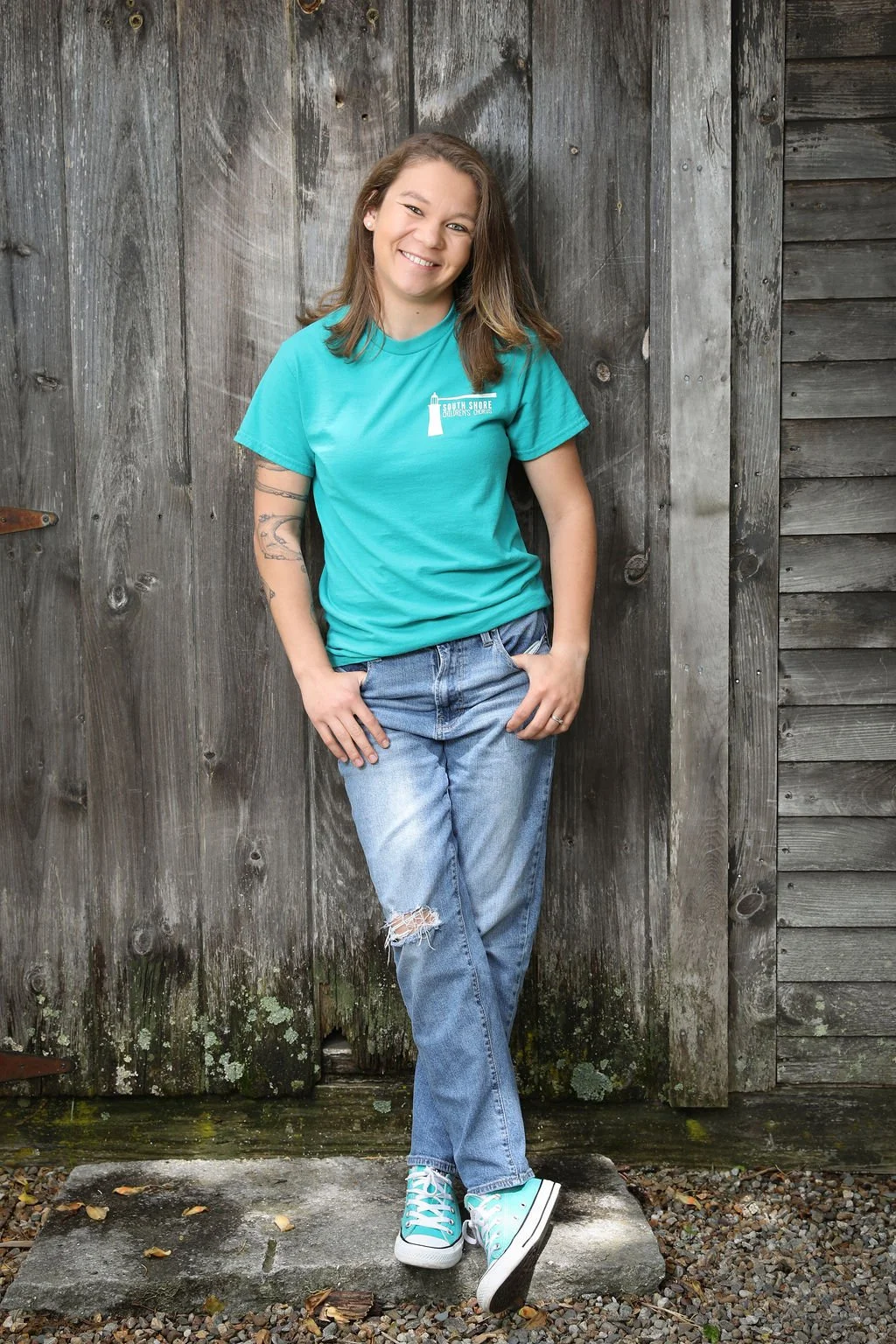
The secret behind the video is that the joy comes from actually doing less. With each group, we rehearse only three songs in a five-month period. Because we are doing less music, we have time for other things. I can take rehearsal time for that socialization. I can take rehearsal time for that community building. Instead of saying, " Okay, you’re going to do six songs. What makes South Shore Children’s Chorus special is that even seemingly simple decisions are made with intention. For example, we wear t-shirts and jeans for our concerts. Why do we wear t-shirts and jeans? We wear t-shirts and jeans because it is an equalizer. It is an intentional choice to be inclusive.
What is the most joyful moment in your memory that validates your decision to begin this incredible organization?
I am a big believer in surprise and authentic joy. During last year’s summer program, we lost power for most of the week and we couldn’t use the entire building we had rented. The whole week was so stressful. We had to move the concert, and move hundreds of people, move different rooms, and everything felt chaotic. Our finale was going to be “Unwritten” by Natasha Bedingfield. I kind of had this thought, what if I got to the lyrics, “release your inhibitions,” and then I blew teal confetti at the children. A surprise. Nobody knew it was going to happen? So all of this stuff is happening around me, the staff was exhausted. The day before the concert, we had to rent a moving truck and move all our equipment. I bought these two confetti cannons, and they were just sitting in my car. I looked at my staff a couple of hours before the concert when the kids had gone home to change, and I said, “I know this week has been long, but I have this idea.” If you open up the home page of my website, you’ll actually see a video in slow motion of all the kids and staff just jumping up and down in this teal confetti rain. They’re leaping for joy as they’re singing and they’re looking up, grabbing for it, teary-eyed. In that moment of wonder, I thought they might not even sing; they might be so confused as to what was going on. But I’d rather give them this memory of joy, this memory of wonder, this memory of singing in this confetti than have a “perfect” performance. To me, that’s what it’s about, right?
It was one of the best moments of my teaching career. It was just healing. Because I had to trust—I couldn’t see my admin on the other side, and so I just conducted, and the confetti came, and it was just so beautiful.
After the concert, I received so many emails and texts from parents with stories of being in the grocery store, and “Unwritten” by Natasha Bedingfield just came on the radio and their kid is dancing up and down the aisle. Whenever that song comes on, the students from camp are going to have this memory of when they were in chorus and it rained confetti. And that joy is going to come back to them over and over and over again. And whether or not they decide to be musicians in life, whether or not they decide to keep singing, they’re not going to walk away from chorus saying, “I hated it.” They’re not going to walk away from the chorus saying it was a bad experience. They’re going to walk away with this memory of unexpected wonder and joy. Later in life, when they have kids, and their kid comes home and asks, “What should I choose for my music elective?” Maybe, just maybe, that will say, “You know what I loved when I was your age?” They might even navigate to YouTube and find that video, and they’ll show their kid. I think that’s how we move art forward. We create these core memories of joy through art with people that they can then share.